By Abishek P Chandran , Leobiss International | Last updated: September 2026
Quick answer
- Who can apply: Indian students aged 17+ by 31 December of the admission year, with 10+2 (Physics, Chemistry, Biology, English), typically 50% (General) or 40% (reserved categories).
- NEET: You must qualify NEET-UG. A qualifying score is enough; a top rank is not needed.
- Duration: About 6 years: at least 54 months of study plus a 12-month internship, as per NMC rules.
- Total cost: Roughly ₹25-65 lakh all-in, depending on country and university.
- To practise in India: Clear the FMGE (NExT is proposed as its replacement) and register with NMC.
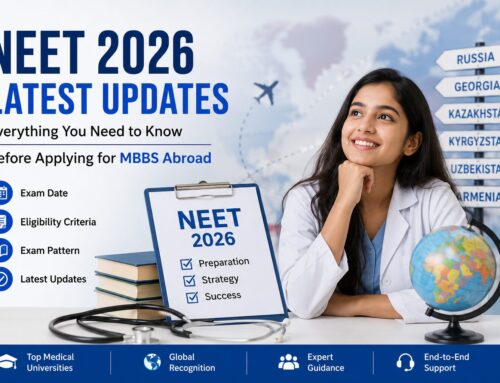
Every year, lakhs of NEET aspirants compete for a limited number of MBBS seats in India, and private colleges can cost ₹60 lakh to ₹1.5 crore. For many families, studying abroad is the realistic route. It only works if you pick an NMC-compliant university and follow the rules from day one. This guide covers fees, eligibility, the NEET question, and the admission process.
MBBS Abroad Eligibility 2026
- Age: 17 years completed by 31 December of the admission year.
- Academics: 10+2 with Physics, Chemistry, Biology and English. Most universities want 50% in PCB (40% for SC/ST/OBC).
- NEET-UG: A qualifying score is mandatory (50th percentile for General, 40th for reserved categories). Your scorecard is commonly accepted for admission abroad for up to three years.
- NMC Eligibility Certificate: Required for Indian citizens before enrolling abroad, and later for the licensing exam.
- Valid passport and medical fitness.
Is the university NMC-compliant? Under the Foreign Medical Graduate Licentiate (FMGL) Regulations 2021, your course must:
- Run at least 54 months of academic study, followed by a 12-month internship
- Be taught fully in English, with clinical training in person (no online or correspondence degrees)
- Include the internship at the same institution
- Make you eligible to practise in the country where the degree is awarded
MBBS Abroad Without NEET: The Truth
You’ll see “MBBS abroad without NEET” advertised everywhere. Some foreign universities do admit students without it. But if you’re an Indian citizen who wants to practise in India, NEET qualification is mandatory. Without it you can’t get the NMC Eligibility Certificate, can’t sit FMGE/NExT, and your degree can’t be used to practise in India.
The good news is that you don’t need a high NEET rank, only the qualifying percentile. Even a modest qualifying score keeps the door open.
Red flags:
- “Guaranteed admission, no NEET needed”
- No mention of the NMC Eligibility Certificate
- Fee quotes with no written breakdown
- Universities that can’t show clinical hospital partnerships
If you haven’t qualified NEET: Retake NEET before choosing a country, or consider allied health and biomedical courses. Don’t gamble on a degree that can’t lead to a licence.
MBBS Abroad Fees 2026 (Total 6-Year Cost)
| Country | Approx. total cost (₹ lakh) | Good to know | Uzbekistan | 22-40 | Budget-friendly; check current NMC advisories | Kazakhstan | 22-40 | Mix of public and premium English-medium programmes | Kyrgyzstan | 25-40 | Low tuition; check total cost, not just fees | Russia | 25-50 | Widest range, from regional to premium universities | Georgia | 35-65 | English-medium; higher living costs | Private college in India | 60-150 | For comparison |
Indicative ranges. Always ask for the university’s current fee letter.
Usually included: tuition, hostel, food, visa, insurance.
Usually extra: flights, winter clothing, FMGE/NExT coaching, personal spending. Budget roughly ₹1.5-2.5 lakh a year.
Most universities accept instalments, and exchange-rate movement can change your INR cost, so keep a buffer.
MBBS Abroad Admission Process
- Confirm eligibility: NEET qualified, 10+2 marks, age.
- Shortlist universities: Check NMC compliance, clinical exposure, FMGE pass record, and safety.
- Get a written fee breakdown for all six years.
- Apply: Passport, 10th and 12th marksheets, NEET scorecard, photographs, birth certificate.
- Receive the admission or invitation letter from the university.
- Apply online for the NMC Eligibility Certificate.
- Pay the first-year fee, then apply for the student visa and attest documents.
- Fly out and register. Most universities start their main intake between August and October.
After Graduation: FMGE/NExT
To practise in India, you must clear the FMGE and register with NMC. The pass rate is low, so the graduates who succeed usually start preparing in year 3 of their course, not after returning home. NExT is proposed to replace FMGE, so check the latest NMC and NBEMS notices for your batch.
Why Families Choose Leobiss
Leobiss International has 18+ years of experience, has guided 10,000+ students, is ISO 9001:2015 certified, and works with universities across 22+ countries. We check NMC compliance before we shortlist, give written fee breakdowns, and guide you from NEET eligibility to visa and pre-departure.
Book a free counselling session: +91 96565 68768 | WhatsApp us